
HMO Fire Risk Assessments: What Assessors Find Most Often
The same few problems turn up in HMO after HMO, and each one matters more where unrelated households share one staircase.
What makes an HMO fire risk assessment different?
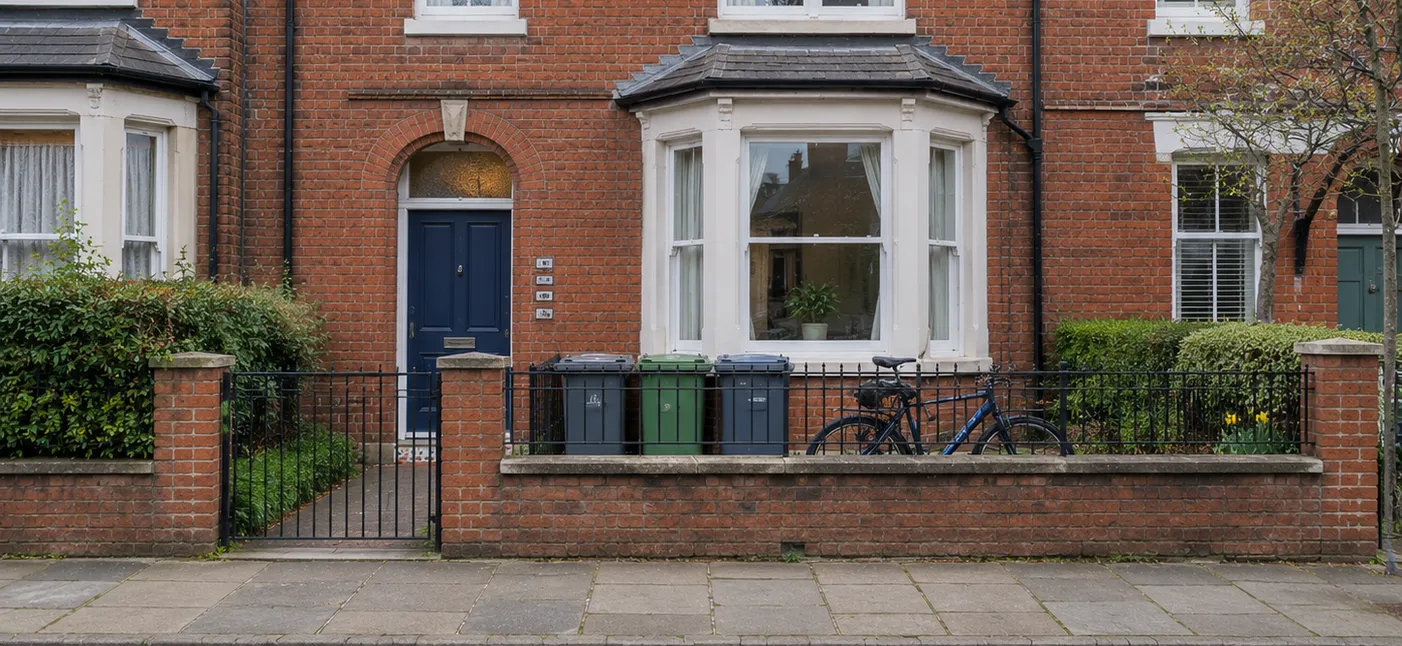
From the street, a five-bedroom terrace let room by room looks like any other family home. Inside, it works very differently. Five unrelated households sleep behind five separate doors, all opening onto the same staircase, and two of the rooms have a hob in the corner. A family home relies on people who know each other waking each other up when something goes wrong. An HMO has to be assessed for people who may not.
That difference is why the same problems turn up in HMO after HMO. This article covers England, where assessors and councils still measure HMOs against the LACORS guidance on fire safety in existing housing, read alongside BS 9792:2025.
Are the letting-room doors up to standard?
In an HMO, the door to each letting room is what stands between a fire in that room and the staircase everyone else depends on to get out. The same findings come up again and again: ordinary internal doors where fire doors are needed, self-closers that have been removed, disconnected or no longer pull the door into its frame, doors wedged open (the kitchen door more than any other), and smoke seals that are missing or painted over.
What counts as a defect depends on the type of HMO. In a small two-storey shared house, LACORS can accept sound, close-fitting conventional doors. In a bedsit-type HMO, where each room is let separately, it expects 30-minute fire doors onto the escape route and says self-closers will always be needed. That is why a good assessment states clearly which type of HMO the house is before it judges the doors.
Does the alarm system suit the house?
Often the house still has the alarm system that was put in for a family: a couple of battery smoke alarms in the hall and nothing in the letting rooms. That may have been reasonable before the house was let room by room, but in a bedsit-type or larger HMO it is rarely enough.
The standard to measure against is BS 5839-6:2019+A1:2020, which sets the grade and category of system according to the type and size of the HMO. LACORS gives guidance on alarms too, but the government’s own housing guidance now describes it as out of date on domestic fire detection, so the current standard should take priority.
Kitchens, and bedsits with cooking facilities, need heat detection rather than smoke detection. A smoke detector close to a hob can go off whenever someone burns the toast, and false alarms are the usual reason residents end up covering or disconnecting detectors.
Are residents cooking in their rooms?
In an HMO, cooking rarely stays in the kitchen. A hob placed next to a bedsit door means anyone leaving the room has to walk past the cooker to get out. In rooms let without any cooking facilities, assessors still find microwaves, mini ovens and air fryers. Where a room does have cooking facilities, the assessor checks that they are safely sited, that the room has heat detection and that a fire blanket is within reach.
What is being stored on the escape route?
Shared hallways and landings fill up quickly with bikes, prams, furniture left behind by a previous tenant and recycling waiting for collection day. The Management of HMOs (England) Regulations 2006 require the manager to keep the means of escape free from obstruction, so clutter in the hall is a management failure as well as a fire risk.
E-bikes and e-scooters are a more recent finding, and a serious one. They are often charged in the hallway or under the stairs because there is nowhere else to put them, and a battery fire on the only escape route puts every resident at serious risk.
Can everyone get out without a key?
LACORS says final exit doors in HMOs should always open from the inside without a key, usually with a thumb-turn, and it strongly recommends the same for each letting-room door. Even so, assessors still find front doors with deadlocks that need a key on both sides. They also find escape routes that pass through a kitchen or lounge, and inner rooms, reached only through another room, with no alternative way out.
Is the structure still holding back fire and smoke?
Many HMOs are older houses that have been altered more than once, and each round of work tends to leave holes behind: new cabling through ceilings, gaps around pipes, a fanlight swapped for plain glass, cracked lath and plaster. None of it is obvious from the hallway, which makes it easy to miss, but all of it gives fire and smoke a way into the staircase.
What has changed since LACORS?
LACORS was published in 2008, and alarms are not the only area where it has fallen behind. The clearest change is on extinguishers. LACORS recommended one on each floor of the common parts, but the government’s June 2026 operating guidance on fire hazards under the housing health and safety rating system says it is “not normally considered necessary, or appropriate” to provide them in the common parts of HMOs and blocks of flats. Extinguishers that are already fitted still need maintaining, and the assessment should record what is there and why.
Do the records show anything was checked?
An assessment is only as strong as the evidence behind it, and records are where HMOs often fall short. Alarm tests with no log, emergency lighting with no record of its monthly and annual tests, and no servicing certificate for a Grade A system are all common gaps. Some councils’ licence conditions require those certificates to be produced on request, so a missing record can turn into a licensing problem too. Good record keeping is what shows the checks were actually done.
How often should it be reviewed?
Twelve months is the standard, and sooner if anything changes, which in an HMO happens often: a room converted into a bedsit, building work, new residents moving in, a fire or a near miss. Whoever carries out the review should be competent, and our guide to who can carry out a fire risk assessment explains how to check.
Fire Record is a fire risk assessment app for assessors. A firm can build its own HMO checklist once and have it used automatically for every HMO, so the same questions are asked on every visit. Notes, voice notes and photographs are captured on site, with or without signal, and each finding is drafted from the assessor’s own notes. Find out more at firerecord.co.uk.
Related Articles
How Often Should a Fire Risk Assessment Be Reviewed?
Twelve months is the standard interval for reviewing a fire risk assessment, and here is what forces an earlier one, and when a review is not enough.
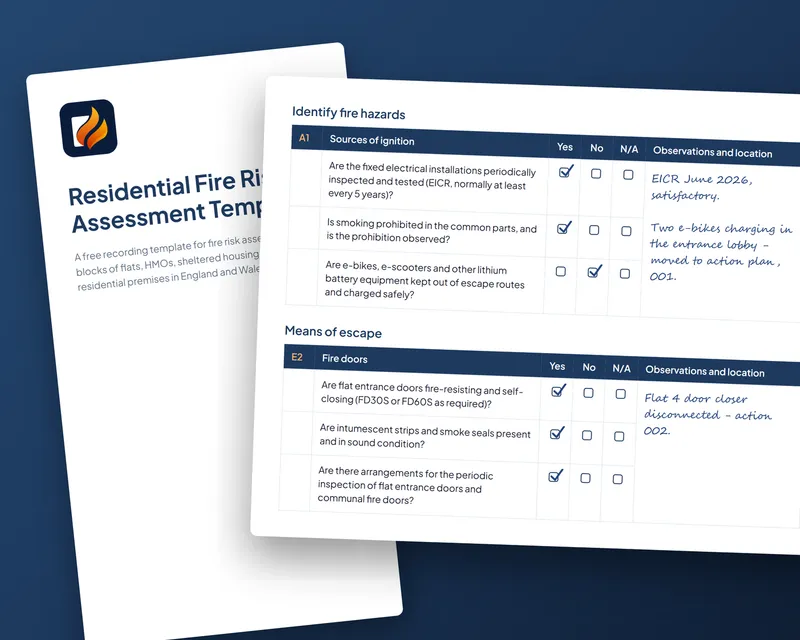
Free Residential Fire Risk Assessment Template: Download in PDF or Word
Download a free residential fire risk assessment template for blocks of flats, HMOs and sheltered housing. Structured to BS 9792:2025, in PDF or editable Word, no sign-up.
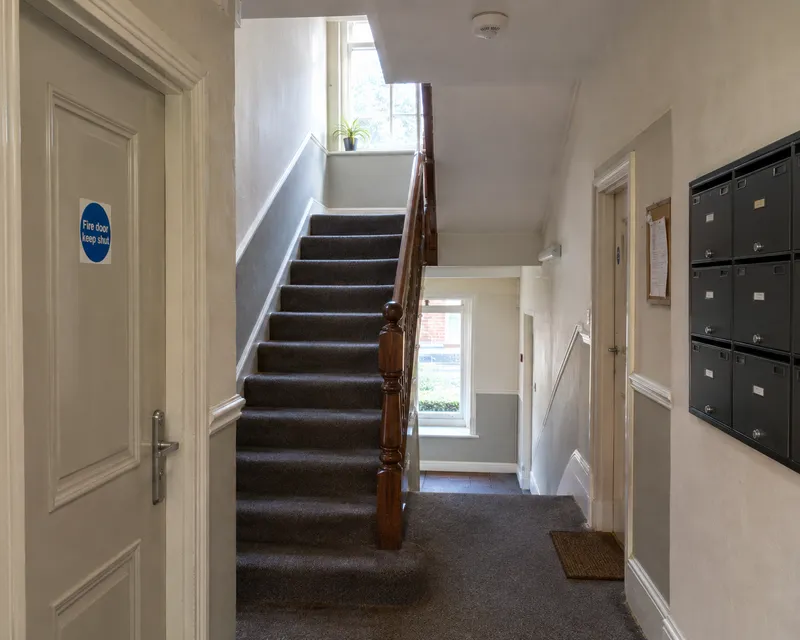
Landlord Fire Risk Assessments: Which Properties Need One
When landlords in England need a fire risk assessment, what it must cover in HMOs and blocks of flats, and the duties that apply to every rented home.